
Yes, you can file an R&D credit amended return to claim a federal research credit (IRC §41) you missed. Attach Form 6765 and file within 3 years of the date the original return was filed, or 2 years from the date the tax was paid, whichever is later. As of fall 2026, tax years 2023 and 2024 are open for most businesses. Tax year 2022 is open only if that return was filed on extension, and those windows close around mid-October 2026.
If your business has never claimed the R&D tax credit, or claimed it but left qualifying work out, you don’t have to wait until next year to benefit. An R&D credit amended return is a standard, IRS-recognized way to recover credits from prior years. It is not an aggressive strategy, but it comes with hard deadlines and specific filing requirements, and a few traps can sink a claim.
Key takeaways
- 1Lookback. Generally 3 years from the date you filed the original return (IRC §6511). A return filed early counts as filed on its original due date.
- 2Required information. The IRS requires three items for a valid refund claim. It dropped two earlier requirements on June 18, 2024.
- 3Grace period ending. Through January 10, 2027, the IRS gives you 45 days to fix an incomplete claim. After that, file it complete or risk rejection.
- 4Closed windows. The small-business §174A retroactive election and the late §280C election both closed on July 6, 2026. The payroll tax offset can’t be elected on a late amended return.
How far back can you file an R&D credit amended return?
You have 3 years from the date you filed the original return, or 2 years from the date you paid the tax if that is later. The clock runs from the actual filing date, so businesses that filed on extension have more time than businesses that filed in the spring.
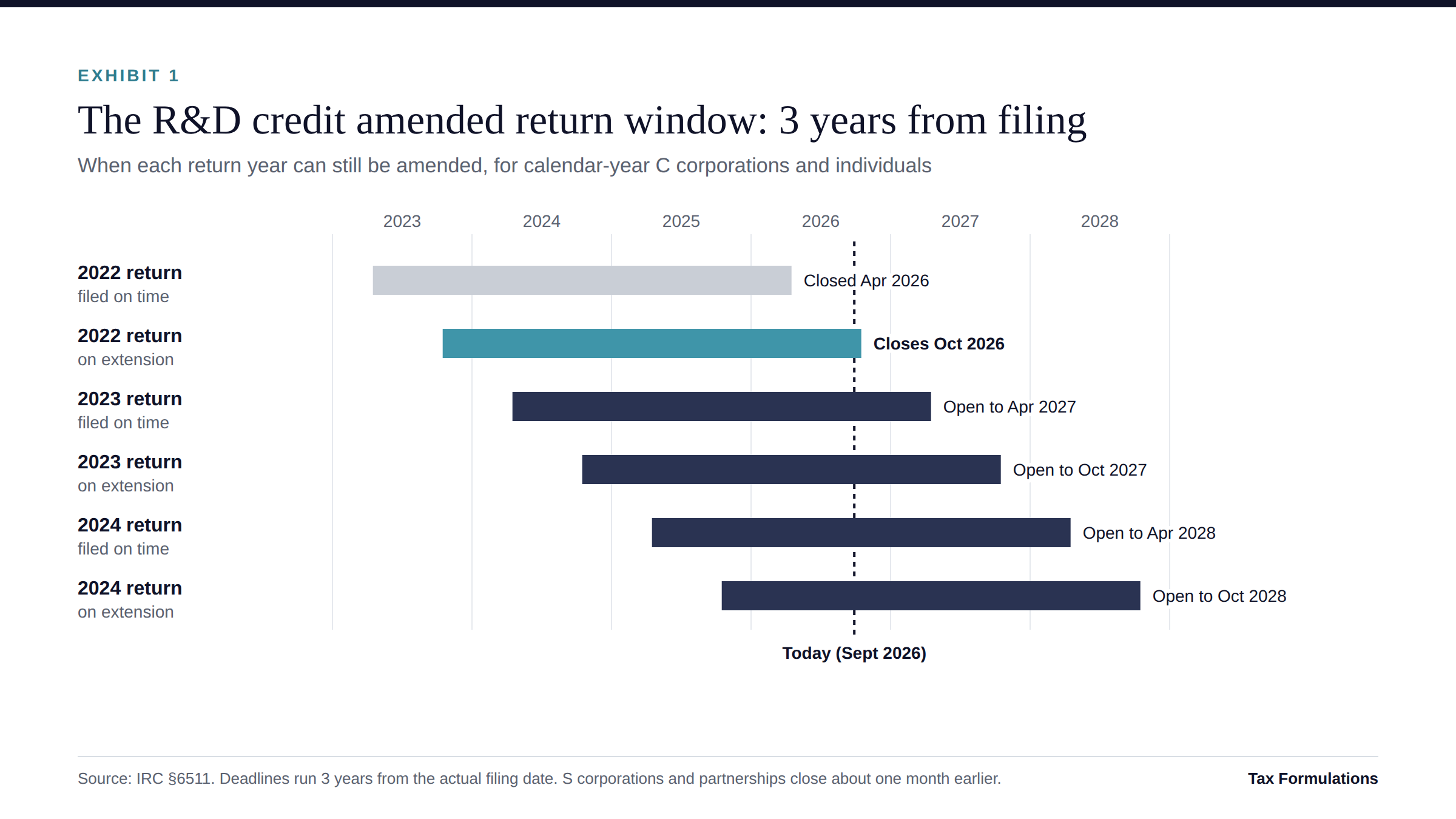
| Tax year | Filed on time | Filed on extension | Status |
|---|---|---|---|
| 2022 | Closed (spring 2026) | C corps & individuals: until about mid-October 2026 S corps & partnerships: closed mid-September 2026 |
Closing now |
| 2023 | Until March–April 2027 | Until September–October 2027 | Open |
| 2024 | Until March–April 2028 | Until September–October 2028 | Open |
Assumes a calendar-year business. Tax year 2021 is closed for nearly every business unless the original return was filed late. Fiscal-year and late filers should count 3 years from the actual filing date on the return transcript.
Check your filing date before you assume a year is closed. A C corporation that filed its 2022 return at the October 2023 extended deadline can still file an R&D credit amended return for that year until mid-October 2026. After that, the 2022 credit is gone for good.
What the IRS requires in an R&D credit amended return
Since June 18, 2024, a research credit refund claim is valid only if it includes these three items:
- Every business component (product, process, software, technique, formula or invention) the claim relates to for that year. Name each one specifically. “Software development” is too vague to defend. “Real-time notification engine for our mobile platform” is specific enough.
- The research activities performed for each business component.
- Total qualified research expenses for the year: qualified wages, supplies and contract research. Completing Form 6765 satisfies this item.
The IRS first set out these requirements in a 2021 Chief Counsel memorandum. That version also required you to name every individual who performed the research and the information each person sought to discover. The IRS waived both of those items effective June 18, 2024. Keep that detail in your files anyway, because an examiner will ask for it.
The 45-day grace period ends January 10, 2027. Until then, if the IRS finds a claim incomplete, it sends a notice and gives you 45 days to supply the missing information. The IRS accepts that information only on paper or by fax. After January 10, 2027, an incomplete claim may simply be rejected, and if the statute of limitations has run by then, you can’t refile.
On Form 6765, Section G (business-component detail) is optional for tax years beginning before 2026. It becomes required for tax years beginning after 2025, with exceptions for qualified small businesses taking the payroll offset and for smaller claimants filing original returns.
How to file an R&D credit amended return, step by step
- Confirm the year is still open. Find the filing date on your return or IRS transcript and count forward 3 years.
- Identify qualifying activities for that year. Test each project against the four-part test, using records from the year you’re amending, not current-year data.
- Calculate qualified research expenses and the credit. You can elect the Alternative Simplified Credit (ASC) on an amended return, as long as you didn’t already claim a research credit for that year on an original or earlier amended return.
- Complete Form 6765 and attach the three required items described above.
- File the right amended return for your entity:
- C corporations: Form 1120-X
- S corporations: Form 1120-S with the “amended return” box checked. Shareholders then amend their own returns to pick up the credit.
- Partnerships under the centralized audit regime (BBA): an Administrative Adjustment Request (AAR)
- Sole proprietors and flow-through owners: Form 1040-X
- Amend your state return, too. Many states have their own R&D credit. See our state R&D credit guide and our California R&D credit guide.
- Plan for processing time. Amended business returns are processed manually and commonly take many months.
Never claimed the R&D credit?
Prior years may still be open. Martin personally reviews every request, and the eligibility review is free.
What you can’t do on an amended return
- Elect the payroll tax offset after the deadline. Qualified small businesses can apply up to $500,000 of R&D credit per year against payroll taxes, but the election must be made on a return filed by its due date, including extensions. An amended return filed after that date can claim the income tax credit but not the offset. How the payroll offset works
- Make a late §280C reduced-credit election. OBBBA gave small businesses a one-time window to make or revoke this election on amended returns for pre-2025 years. That window closed on July 6, 2026.
- Make the small-business §174A retroactive election. Businesses with average annual gross receipts of $31 million or less could amend 2022–2024 returns to expense domestic research costs immediately. Rev. Proc. 2025-28 set the deadline at July 6, 2026, and it has passed.
What’s still available for Section 174: any business can deduct its remaining unamortized 2022–2024 domestic research costs on its 2025 return, either all in 2025 or split over 2025 and 2026. If your 2025 return is on extension (due October 15, 2026 for calendar-year C corporations and individuals), make that decision in this filing. Read our Section 174 guide
What is an R&D credit amended return worth? A worked example
Take a manufacturer that spent $500,000 on qualified research in each year from 2020 through 2023 and never claimed the credit. It files an R&D credit amended return for 2023 using the Alternative Simplified Credit:
| Average QREs, prior 3 years (2020–2022) | $500,000 |
| Base amount (50% of the average) | $250,000 |
| 2023 QREs above the base ($500,000 − $250,000) | $250,000 |
| Federal credit (14% × $250,000) | $35,000 |
That’s for 2023 alone, before any state credit. If 2024 is also unclaimed, the company can amend that year as well. This example is simplified. Your actual credit depends on your expense history and your tax position.
Does an R&D credit amended return increase audit risk?
The IRS reviews every refund claim before it pays, and R&D credits are an enforcement priority. Two things to know:
- The risk comes from weak support, not from amending. Businesses that documented their projects and experiments as the work happened can defend a claim. Businesses that rebuild everything from memory years later often can’t.
- The IRS can look at the whole return. When it evaluates your refund claim, the IRS can reduce the refund for errors it finds elsewhere on that year’s return, even errors it could no longer assess on their own (Lewis v. Reynolds, 1932). Review the full return before you file.
Read our R&D audit preparation guide for what examiners look for.
Frequently asked questions
Can you file an R&D credit amended return?
Yes. You can claim a missed federal R&D credit by filing an amended return with Form 6765 and the three items the IRS requires, as long as the statute of limitations for that year is still open.
How many years back can I claim the R&D tax credit?
Generally 3 years from the date the original return was filed, or 2 years from the date the tax was paid if that is later. For most calendar-year businesses in late 2026, that means tax years 2023 and 2024, plus 2022 if the return was filed on extension.
Is it too late to amend my 2022 return for R&D credits?
It depends on when you filed. A 2022 C corporation or individual return filed at the October 2023 extended deadline can be amended until mid-October 2026. A 2022 return filed in spring 2023 can no longer be amended.
What information does the IRS require for an R&D refund claim?
Three items: every business component the claim relates to, the research activities performed for each component, and total qualified wages, supplies and contract research for the year. Form 6765 covers the expense totals.
Can I claim the R&D payroll tax offset on an amended return?
Generally no. The payroll tax election must be made on a return filed by its due date, including extensions. An amended return filed after that date can claim the income tax credit but not the payroll offset.
How long does an amended R&D refund take?
Amended business returns are processed manually and commonly take many months. If your claim is incomplete, the IRS may send a notice asking for more information, which adds time. Filing a complete claim is the best way to avoid that delay.
Do I need to amend my state return too?
Usually, yes. States with their own R&D credit, such as California, generally require their own amended return and state credit form. Federal changes can also affect state taxable income.
Find out what you left unclaimed
We review your open tax years, calculate the credit for each one, prepare the documentation the IRS requires, and coordinate the amended filings with your CPA.
CPAs: if your clients have open years and unclaimed credits, we handle the lookback study and claim documentation while you keep the relationship. See how our CPA partnership works
New to the credit? Start with our R&D tax credit guide
Martin Gamez, Founder, Tax Formulations
Martin is a tax credit specialist with over 25 years of experience in federal and state R&D tax credits, cost segregation and business tax incentives. His practice includes retroactive R&D credit studies and amended return preparation for businesses that have never claimed the credit. Read full bio
Sources: IRC §6511 · IRC §41 · Treas. Reg. §1.41-9 · IRS: Research Credit Claims on Amended Returns FAQs · IRS: Instructions for Form 6765 (Rev. Dec. 2025) · Rev. Proc. 2025-28. This article is general information, not tax advice for your specific situation.